Friday, June 24, 2011

Talking Heads - '77


★★★★★ Tracks:
Uh-oh, Love Comes to Town
New Feeling
The Book I Read
Psycho Killer


As creative as the Talking Head’s were when they started to implement afrofunk on Fear of Music and Remain in Light, I enjoy their earlier work a lot more, when they were a more straightforward rock’n’roll group. But even in the beginning I imagine the 'Heads are probably one of the first bands to be classified as ‘art rock.' While the label has always sounded rather pretentious, it just seems to make sense when identifying groups that write cerebral and strange lyrics or compose more complex instrumentation thank your average pop/rock outfit, or in the case of the 'Heads, both. And really, David Byrne seems like a pretty pretentious guy anyways. But as evidenced by ’77, the entire record being written by Byrne, he backs that arrogance up with some of the most unique music of the late 70's and early 80's.


The guitar work here is elaborate, and implements a bit of the funk they would further incorporate a few years later. Byrne talks a bit about the government (“Some civil servants are just like my family” in “Don’t Worry About the Government”) about every day problems (“they say compassion is a virtue / But I don’t have the time” on “No Compassion”), about how great he is (“I’m a know it all / I’m the smartest man around” on “Uh-oh, Love Comes to Town”), but one of the odd, most reoccurring themes is his fascination with social politics between men and women (“Girls ask and I define decision / Boys ask and I describe their function” on “Tentative Decisions”), and all of these lyrics further the image of the frontman as a rather distraught weirdo; the anxious, rambling voice the sound of a man who should be medicated. His neuroses are our gain though. And who doesn’t love to give it their all when singing “Psycho Killer” on Rock Band?

Thursday, June 16, 2011

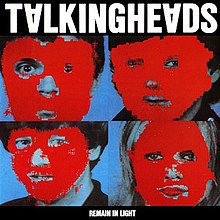
Talking Heads - Remain in Light


★★★★★ Tracks:
Crosseyed and Painless
The Great Curve
Once in a Lifetime


When I play a Talking Heads record I inevitably think about how awesome it would have been to have been around during the CBGB heydays of the late 70’s. It was probably an intimidating scene, with a crowd made up mostly of social outcasts hoping to catch a glimpse of punk rock pioneers like the Ramones or Television or Patti Smith or Blondie (wow). With their business-casual attire and pretentious, artsy demeanor, the Heads must have been the oddballs of the bunch. They probably fit in much better with the white-collared Manhattanites surrounding them. Furthering the image, David Byrne’s nervous, edgy, even chaotic, vocal style makes him sound incredibly smart, but incredibly strange, as if his brain holds more information than one brain can capably handle. He sounds like what I imagine the late 70’s and early 80’s represented in general; it was the dawn of sensory overload. And while most of the CBGB crew were busy revolting against the changing times, the Heads and the music they created appeared to embrace the epoch of green-screened computers, fast-paced financial activity on Wall Street, and car-polluted freeways surrounding it. Perhaps though, the group was simply approaching the revolt in a different manner.

The first Heads song I heard was “Once in a Lifetime.” The video, one that got heavy MTV circulation even into the late 80’s, in a lot of ways introduces the audience to what the band is all about: the Heads’ frontman, a well-dressed David Byrne massaging his ego and exercising his creative control over the band, is the only member of the group to appear; it uses cutting edge analog and video effects for the time; the music is rhythmic and percussive but monotonous in melody; and Byrne’s vocals sound like an anxious stream of consciousness, a consciousness perplexed by the speed of which life can pass one by.


Ironically Remain in Light wasn’t recorded in the urban sprawls of America, but on the tropical shores of the Bahamas. Married and gaining success from their music, drummer, Chris Frantz, and bassist, Tina Weymouth, purchased an apartment in Nassau, where they quickly gained a fascination for Caribbean and African music. Byrne came down to visit the band soon after the purchase and they immediately began working on their next album, with the idea of heavily incorporating Afro beats, polyrhythmics, and reggae into the record. The finishing product remains true to the process. Every song here is uninflected in melodic structure, as the chord progressions never change throughout each song, but the rhythms are deep in multilayered percussion, and the songs build in strength as more instruments are gradually layered on top of one another. Phenom producer Brian Eno has a lot to do with this, as they essentially used a copy+paste method of recording loops and layers from the band's long studio jam sessions, but remember, this was before we had the convenience of digital music editors. A new method of recording music had been born and no one knew it yet. Always inspired by soul, the Talking Heads were now featuring the building blocks to rap and hip-hop in their music, and even though it took a trip to the Bahamas to inspire the group’s new approach, back in their hometown of New York City hip hop was already beginning to thrive. Perhaps some of this is pure coincidence, but Remain in Light nonetheless showcases how well their music epitomized the time.

Friday, June 10, 2011

The Tallest Man on Earth - The Wild Hunt


★★★★★ Tracks:
The Wild Hunt
Burden of Tomorrow
You're Going Back


“Aww Xavier's on the border of the sun
Swings on the chambers of your guns
And tries to shoot the chord and light the path

Aww but hell I'm just a blind man on the plains
I drink my water when it rains
And live by chance among the lightning strikes”

I don’t know what the hell The Tallest Man On Earth is singing about most the time, maybe I’m just not paying enough attention or maybe I’m too wrapped up in the music. It doesn't matter though, The Wild Hunt perks my ears up every time it sets in motion; Kristian Matsson has quite the gift for the 6-string, and his biting voice, rambling lyrics and bare bones instrumentation bring to mind the days of The Freewheelin’ Bob Dylan, the introspective less preachy version of his many personalities. The album’s run time is just fine but, as regular readers might know by now, I can get burnt out quickly by percussion-less music, even with guitar virtuosity as fine as this. Still, a lot of these songs simply cannot be discounted, most notably; “The Wild Hunt,” “Burden of Tomorrow,” and “You’re Going Back.”

(Best audience still shot ever?)

Thursday, June 9, 2011

Tegan and Sara - Various


★★★★★ Tracks:
My Number
Walking With a Ghost


Soon after college I ended up with a desk job for a large accounting firm. It was a low-level department filled with tons of recent college graduates like myself, making for the most fun and fucked up work environment I will most likely ever be a part of. Endless hours of goofing off in the mail room ensued, and in that mail room we would blare our favorite tunes; anything from Wu-Tang to Garth Brooks on the domestic front and 3 Canal to Ninet Tayeb from the international scene. When management realized shit was getting out of hand, we were dispersed about the office like disciplined first graders in order to settle things down, but that didn’t stop us from using the inter-office instant messaging system to send mp3 files back and forth to one another. It was at this time that one of my closest musical counterparts introduced me to the first Tegan and Sara track I would ever hear. “My Number” has a new wavish, folksy sound hearkening to those singles from the 90’s femme movement (Fiona Apple, Tori Amos, Ani DiFranco, etc). If I make out the lyrics correctly it sounds like Tegan is recounting her issues with identity and sexuality, which makes the song even more interesting knowing what we now know of her.


When I told my friend I had played the shit out of that track, she sent me "Walking With a Ghost" next. In this song, it was obvious the duo had evolved, borrowing heavily from those punk and garage records they must've been collecting over the past few years. Instead of leaning entirely on acoustics and string accompaniments they were blaring electric guitars with distortion while pushing the pitch of their voices to newly grating levels. They began to harness their originality though, and “Walking With a Ghost” became the blueprint for a lot of the group’s later work. Not long afterwards the White Stripes would cover it for an EP. Tegan and Sara are often branded as The Jonas Brothers for the indie teen, and the nod by such a respected rock'n'roll group gave the duo some much needed musical credibility. And as I listen to both tracks back to back a few times over, Jack White’s version can’t touch the original.


Tuesday, May 31, 2011

Tegan and Sara - The Con


★★★★★ Tracks:
The Con
Knife Going In
Back in Your Head
Burn Your Life Down


My wife: “Turn that down! Our neighbors are going to think we’re lesbians...”

Me: “Come on, it’s not that bad,” just as Tegan sings, “I felt you in my legs / Before I ever saw you.”

...Alright, she has a point.


Tegan and Sara - Back In Your Head (Live Conan O'Brien 2007)

Sunday, May 22, 2011

Tegan and Sara - Sainthood


★★★★★ Tracks:
Don’t Rush
Hell
Alligator
Paperback Head
The Ocean


Most anyone who enjoys Tegan and Sara will take a defensive stance when speaking of them, a stance that only arises in the case of guilty pleasures. Just look at that album cover ... I understand the criticism to their perceived packaged hipsterism, the gimmicky imagery of are they lesbians / are they twins / are they lovers / maybe all three? But when I play a track all of that never comes to mind because they craft such great pop rock. They remind me of Fleetwood Mac or Tom Petty for modern day indie enthusiasts; taking bits and pieces of all that great rock over the past 25 years and impressively compartmentalizing it. As well as its infectious nature, the duo have incredible talent for building pop songs from the bottom up, as they write all the material themselves.

I’m starting with their latest release because it’s not only their best work yet, but it also garners the lowest “cheese factor” of the bunch. As these twin siblings have grown and matured before our eyes so has their music. Tegan and Sara pull from all of their influences this time around; the album’s named after a Leonard Cohen lyric (“Came So Far For Beauty), “Alligator” sounds like a Madonna throwback, “The Ocean’s” fast tempo and open-stringed strumming brings Jimmy Eat World to mind, on “Hell,” one of the first tracks to have ever been co-written by both sisters, they show how easily power-chord driven punk rock comes to them, and their increasing infatuation with 80’s new wave is harnessed in songs “Don’t Rush,” “The Cure,” “Arrow,” and “Paperback Head.” Chris Walla of Death Cab fame produces T&S for the second time and he markedly improves the recording quality here, everything sounds crisp, with one of the most impressive aspects being the top-notch, forceful drumming and percussion -- the aspect of the music which really carries these songs forward.


Tegan and Sara - Hell

And sure, there is still plenty that could likely be heard backing the credits to a romantic comedy, or some awfully awkward scene to one of those WB shows my wife might or might not watch; in “On Directing,” even Sara herself realizes her sugar-coated lyricism (“Go steady with me / I know it turns you off when I / I get talking like a teen.”) can induce dry heaves. In the end though I just can’t ever seem to let T&S’s immaturity get to me because the hooks are so fucking good. They'll most likely always write with naive and sometimes immature sincerity, and combined with those abrasive tomboyish voices, the unamused will quickly grow disinterested. But 2009’s Sainthood brought Tegan and Sara from oft-played guilty pleasure to a group producing one of my favorite records of 2009.


Wednesday, May 11, 2011

Television - Marquee Moon


★★★★★ Tracks:
See No Evil
Venus
Friction
Prove It


They were mainstays at CBGB during its heyday in the late 70's, that was about all I knew of Television before their free Central Park show a few years ago. My wife and I walked in a bit late, bought our $12 beers, and watched them play what I now know is the title track to Marquee Moon. The song runs over ten minutes long, with an instrumental interlude spanning the majority of its playtime. They embellished on it live, and what felt like fifteen minutes in I was already finding myself pretty damn bored by the whole thing. It sounded like a garagey version of Phish, a sort of meandering piece of music that never found the hook it seemed to be searching for. Maybe everyone was tranced out or I missed the mushroom party, but the crowd appeared lifeless. The band lacked energy or any sort of stage presence, and at the time I thought these bros from the 70’s just didn't have much steam left in them. But maybe they were playing with heavy hearts. We stayed for a few more tracks and left disappointed.

Undeterred, I bought a copy of Marquee Moon a few weeks after the show. It floored me how immediate and infectious it was. About half way through a live performance I didn't understand the appeal but the opening riff to "See No Evil" left me wearing an unshakable grin. What phenomenal guitar play. I immediately thought of one of my favorite albums, The Strokes’ Is This It (insert typical hipster joke here); I could see Casablancas and Hammond, Jr. sitting around some years ago, picking apart the guitar licks on Marquee Moon while gathering ideas for the dynamic guitar interplay on their debut album some 25 years later. Television uses a dual left/right guitar approach (and as it is with most complex guitar bands, mono is not a good option when playing this record), sometimes layering as many as four and five guitars on to a track at once. Songs like “Venus” and “Friction” have guitar leads that last their entire lengths, mixing in multiple and frequent guitar solos. All too often the solo will sound like such a pretentious piece of shit in rock’n’roll music, but Television uses precision, allowing the solo to improve the overall structure of the song while simultaneously attacking its conventionalism, and they do so with confidence, not arrogance.


I admit I still skip over the sprawling “Marquee Moon” most times through, but damn if their live show didn’t give me a false impression, because Marquee Moon is rock'n'roll guitar virtuosity at its finest.